Without one platform
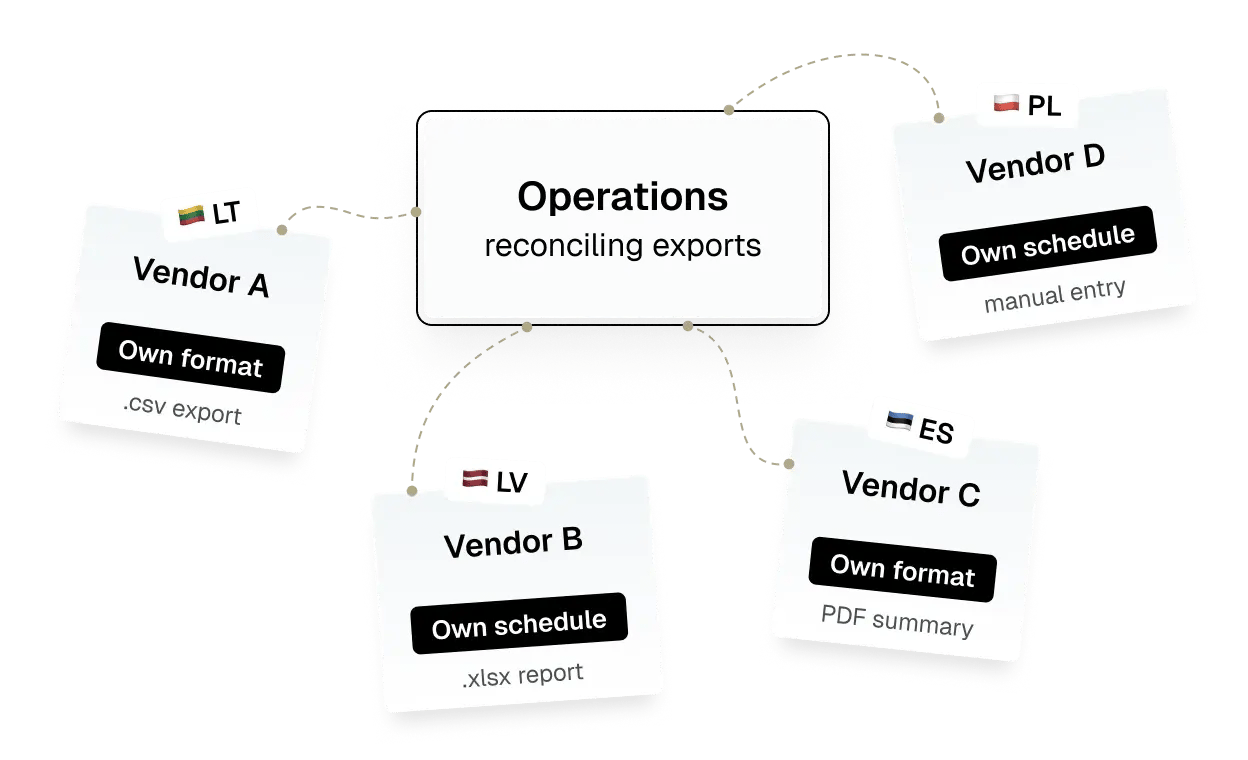
Exports. Time delay. Manual coordination.
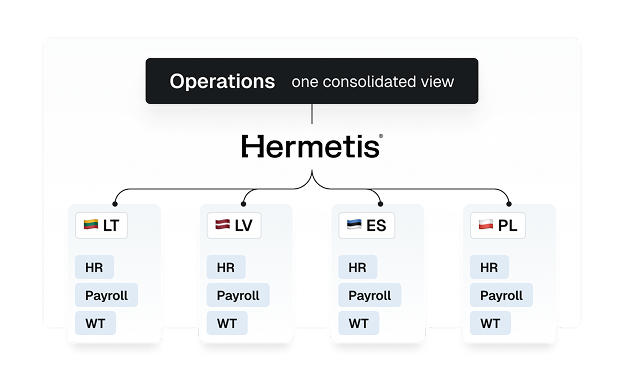
Hermetis is the system HR and Payroll teams use across from one to four countries. Each country's legal entities run under their own legislation, and the view across companies is part of the same platform.
Companies operating in two or more of these markets typically run HR and payroll through a different vendor and system in each country.
Local teams run on different processes, legislation ends up interpreted differently in each entity, and there is no shared process to improve.
Without one platform
Exports. Time delay. Manual coordination.
With
One view in real time. Accurate payroll. Fewer questions to HR teams. Processes that can be optimized.
Hermetis handles each country's compliance by dividing core HR, working time and attendance and payroll. Core HR processes: onboarding formalities, contract management, termination, salary review, probation tracking, organisational structure – are applied consistently across from one to four countries.
Payroll is imposed locally per country, against its own tax framework, social insurance system, and labour code. The customer does not manage the distinction; the system can apply the right rules per country, per process, per employee.
Sodra contributions calculated
GPM income tax with individual exemption tracking
Collective agreement support – separate working time and pay rules per agreement
VSAOI contributions per employee category
VID EDS data exchange with the State Revenue Service
Overtime and public holiday premiums applied per schedule
EMTA income and social tax filing
Tervisekassa integration for sick leave data
Funded pension tracking per employee opt-in
ZUS contributions across all funds
PPK employee capital plan deduction and employer contribution
Overtime cap and minimum wage updates
The legal structure underneath and the operational structure on top run on different axes.
Each country's legal entity is isolated at the data layer; the reporting line connecting managers and employees can cross country boundaries without breaking either compliance or visibility.
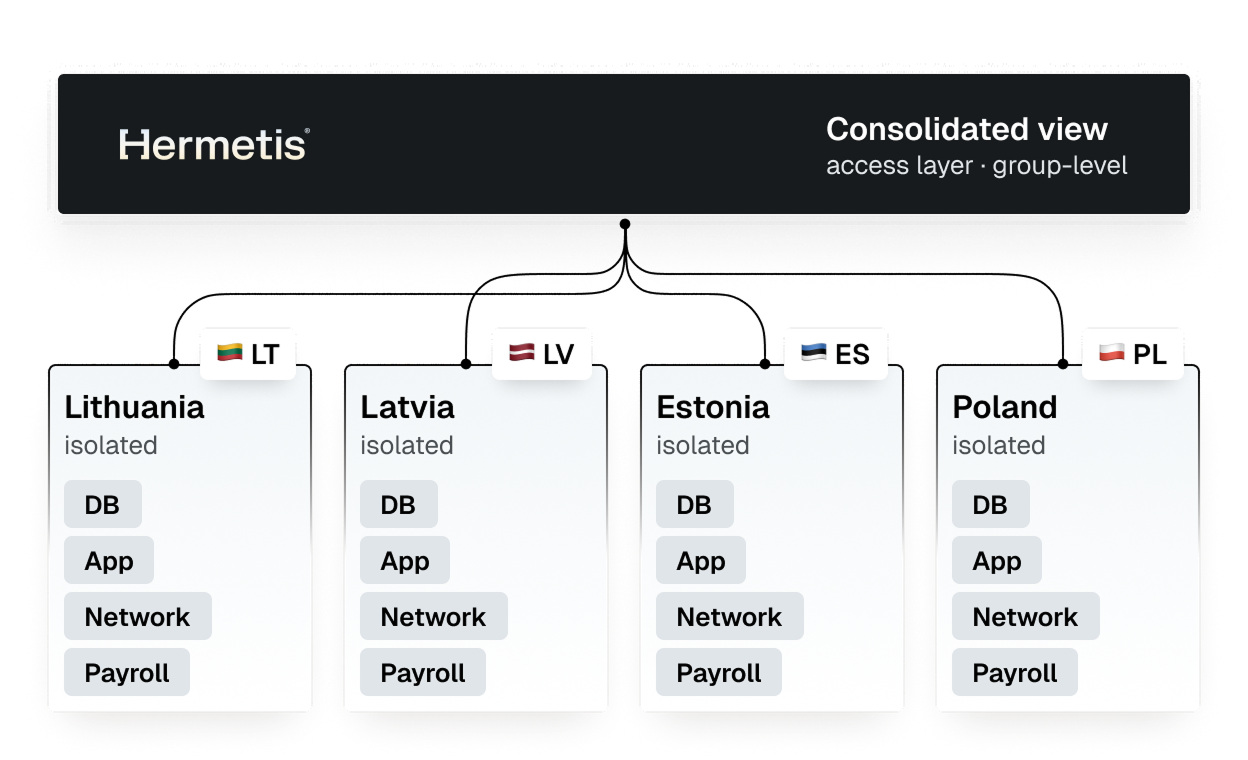
Per‑entity architecture
Each country is an isolated dataset. A group‑level access layer reads across, without moving data between jurisdictions.
The manager sees the full team in one view, approves their requests, and their involvement in a process.
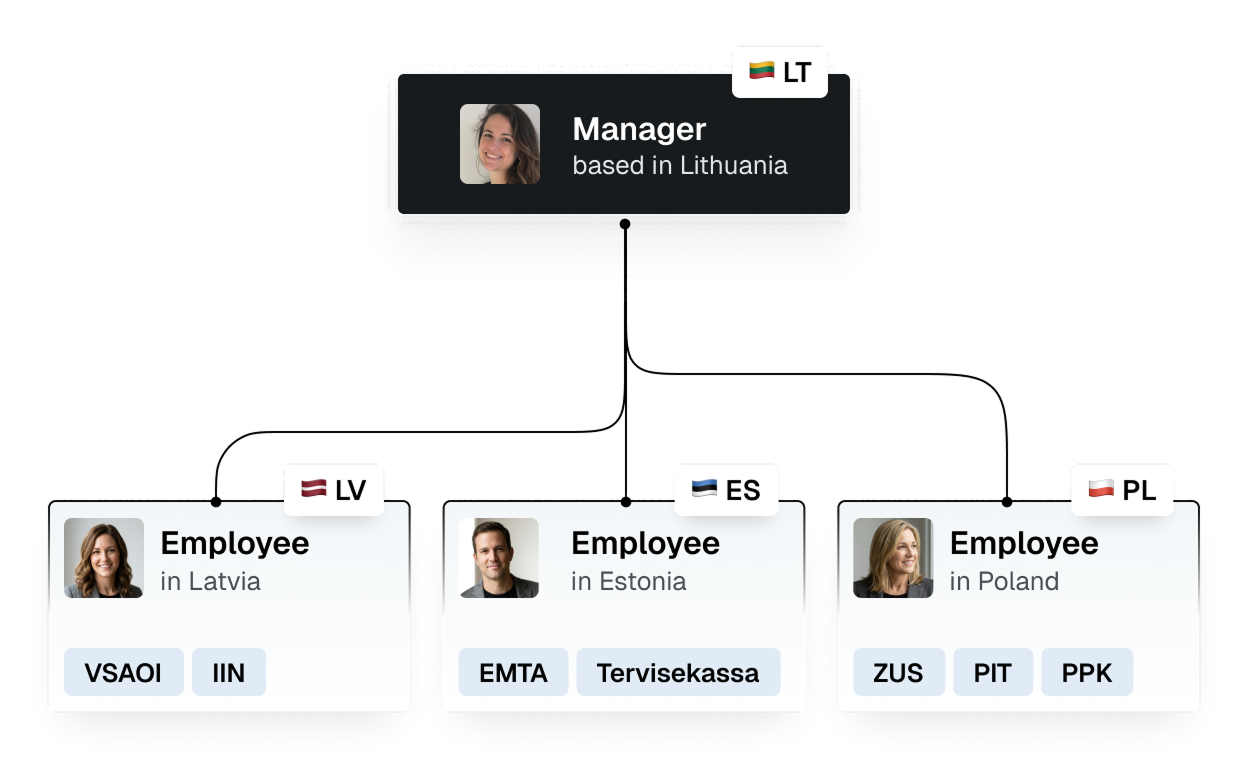
Daily uses of Hermetis across countries.
When absence rates, headcount changes, and cost per employee are calculated the same way in every country, the differences between markets become observable rather than guessed at.
During salary review specifically, managers see real-time budget usage and the salary distribution within their team — and where they have reporting managers below them, they see the aggregated picture for that group as well. Decisions are made with current data, not with a snapshot prepared days earlier.
Probation period endings, fixed-term contract deadlines, and onboarding
responsibilities surface as alerts in the same system that holds the underlying
records.
Probation reminders typically reach the manager around ten days before the date; fixed-term contract reminders, around thirty days. The action required is laid out alongside the alert. Where employees and managers sit in different countries, the same alert mechanism handles the country-specific differences without local follow-up.
When the CFO asks what HR costs across the group, the answer comes from the system that ran the payroll.
Rather than moving figures through hundreds of password-protected spreadsheets between managers and HR, the approved decisions flow from the platform directly into the contract amendments prepared for signature.
A new entity in any of the four markets sits on the same platform; the compliance logic for that country is already in place, and the implementation is a configuration step rather than a separate project.
Every group-level metric is only as reliable as the HR records it is built on. The HR Management module is where those records live – country-governed, controlled-workflow, available across the group through the same access controls as the rest of the platform.
New hires enter their own personal details in Employee Self Service before day one, so the data reaching payroll is correct from the start.
Lorem ipsum dolor sit amet, consectetur adipiscing elit. Suspendisse varius enim in eros elementum tristique. Duis cursus, mi quis viverra ornare, eros dolor interdum nulla.


Once processes run the same way in every country, the conditions for improving them are in place.
The four below are the changes most commonly reported by customers running Hermetis across multiple Baltic and Polish entities.
Runs in the same platform that holds the HR records, with each country's rules applied.
Errors from late updates and manual transcription drop out of the cycle, reconciliation between systems falls away, and statutory reporting per country is generated from the same data set that produced the calculation.
Moves salary reviews from spreadsheets sent and returned by email into a single in-platform process.
Automated reminders to managers will reduce missed deadlines, particularly in international teams where rules differ.
Employees can provide their own details before day one through a secure link, rather than HR transcribing them from emails and forms.
Name Surname
Position, Company name
Luminor brought together six banks across three Baltic countries, this customer introduced a single HR and payroll platform in place of fragmented country-specific systems.
New hires enter their own data before day one, hundreds of emails with salary review runs in the system, and Operations and HR work from a consistent view of the workforce across all three countries.
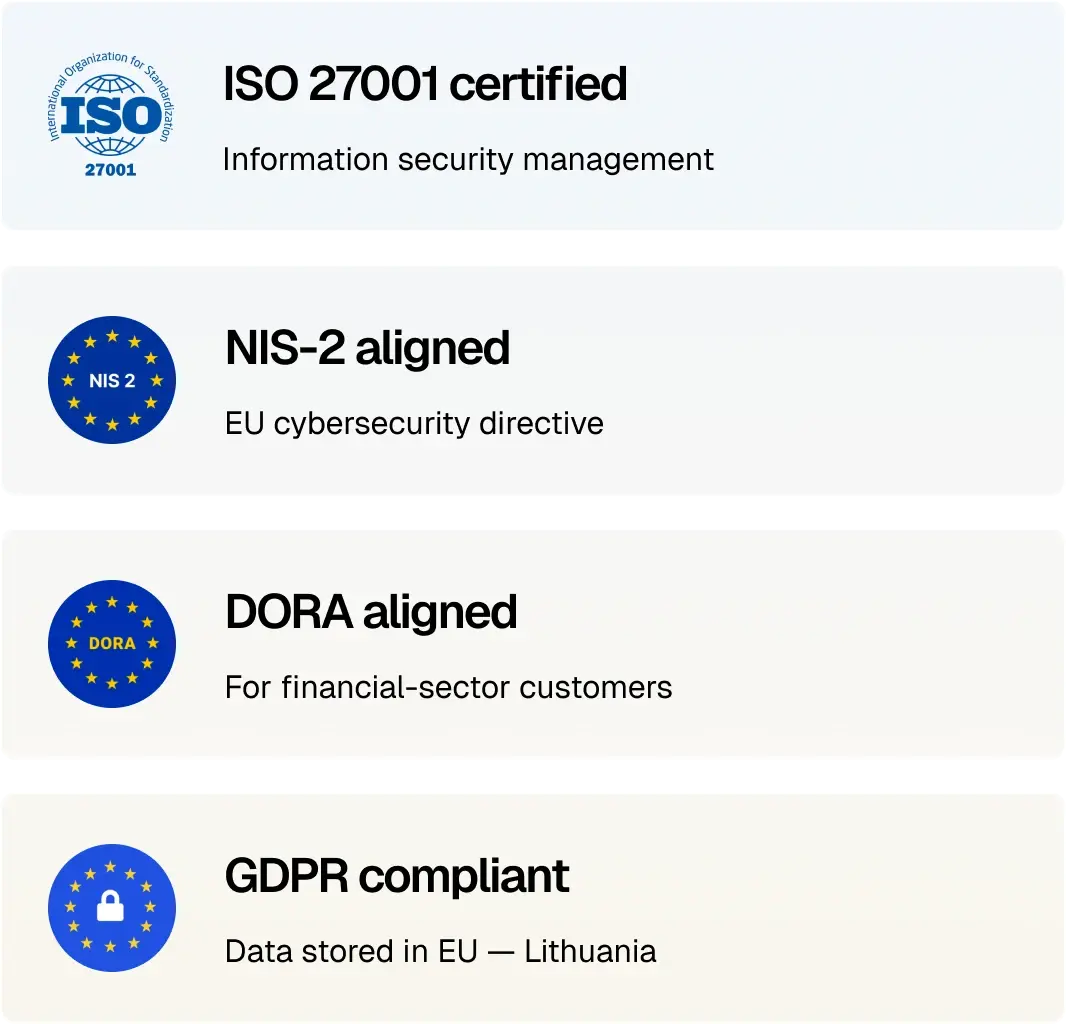
Certified across every country we serve. Every employee's data is stored in the European Union.
The same security posture covers all four countries, under one ISO 27001 certification, one DPA, and one accountable provider.
What you pay depends on the entities you run, the modules you use, and the size of your workforce.
We discuss it in the first meeting, once we understand what your operation looks like.
One meeting is enough to walk through what a consolidated management of your workforce, payroll and data would look like.
Contact us for any more questions.
One shared system. Every Legal Entity across the four countries runs in the same Hermetis environment, with no separate logins per entity and no copying data between instances. A single HR or payroll team works across all entities from one console, while each employee's Legal Entity assignment controls which country's statutory rules apply to them. This is what lets a Baltic group remove the per-country HR-system silos most multi-country employers accumulate.
Each employee's personal data, contracts, salary history, and termination records sit within the Legal Entity they belong to, and each entity follows its own country's data-storage rules. Lithuanian data does not flow into Latvia, and Latvian data does not flow into Estonia. Access is role-based on a need-to-know basis across the whole system, and every access or change is recorded in the audit log, so segregation between entities is enforced by permissions, not just by convention.
Tax rates, thresholds, and working-time rules live in calculation tables rather than in code, and Hermetis maintains them as part of the standard product lifecycle — legislative changes are closely monitored by Product Compliance Managers as configuration in quarterly major releases with the updates pre-applied, not as customer-side projects. This removes the per-change external-consultant engagement that single-country tools usually require. Customers still validate that the vendor's configuration fits their specific circumstances, so compliance is a shared, auditable posture rather than a black box.
Yes. A transfer is processed as a structured document with an effective date, and the employee's history is preserved while new terms apply from the transfer date forward. For a move within the same group, a 'termination for re-hire' scenario keeps employment continuity and tenure-based conditions intact, so the employee is not reset to zero on benefits that depend on length of service.
Group-level reports — staffing list, headcount, headcount distribution, turnover, termination-reason analysis, anniversaries — draw from the canonical workforce data across all entities at once, while each entity's data still stays within its own country. Reports can be scoped to a single entity, a subset, or the whole group, so board-level reporting is available on demand without exporting to a separate BI tool first.
Payroll runs fully isolated per Legal Entity — separate scopes, periods, and payment execution — so each country keeps its own payroll calendar and cut-off, and entities are processed in parallel without forcing a single shared deadline. Cross-entity processing in one run is excluded by design, which keeps each entity in its own jurisdictional context. Payment files, GL exports, and statutory reports are all generated per entity.
Each country runs on its own tax engine and contribution model, and Hermetis applies the current rules. Lithuania and Latvia use progressive income-tax bands while Estonia uses a flat rate, and each country has its own social-contribution structure, non-taxable thresholds (for example on gifts and benefits), and statutory reporting. Because the right rules are applied per Legal Entity, what lands in your general ledger reflects the actual local cost in each country.