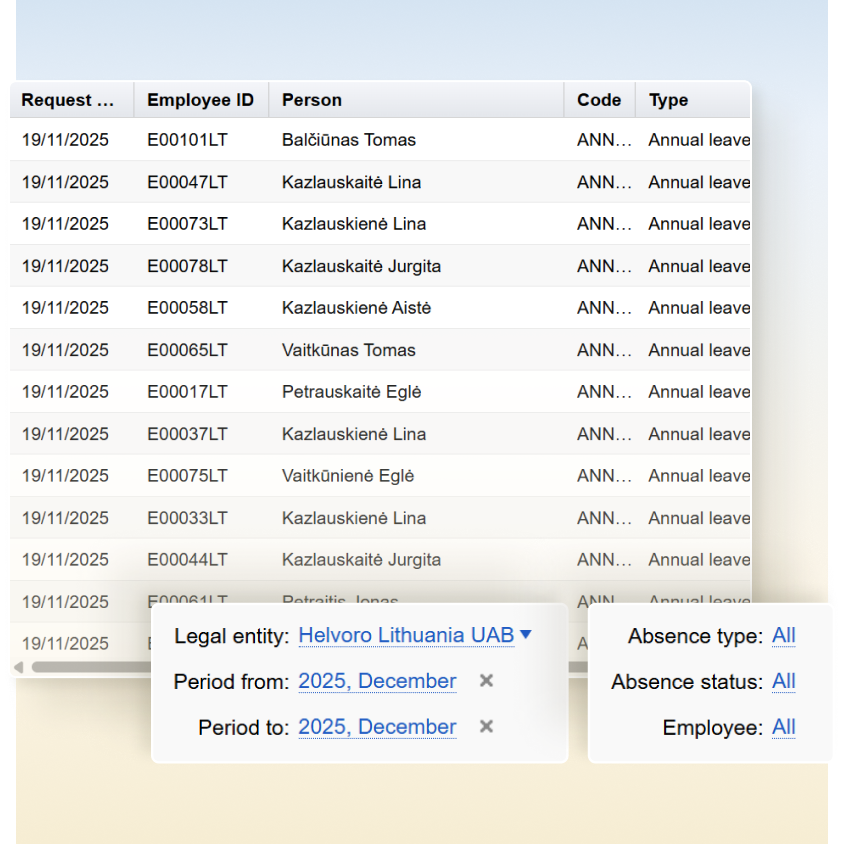
Schedule generated
Monthly schedules generated automatically and assigned to teams.
Manage schedules, track absences, and hand confirmed time data to payroll – for every employee, across Lithuania, Latvia, Estonia and Poland.
Someone called in sick at the last minute. The supervisor adjusted the schedule on the floor. By Friday, when payroll needs the hours, nobody is certain the correction made it into the system. Someone checks. It usually has. But that check happens every month.
A team leader in Vilnius and a team leader in Rīga. Same job, different rules for how overtime is counted at the end of the month. The payroll team knows the difference – and they calculate it manually every time.
The data is there. But someone still has to export it, clean it, apply the rounding rules, and format it before payroll can use it. Every period, the same half-day of work.
Lorem ipsum dolor sit amet, consectetur adipiscing elit. Suspendisse varius enim in eros elementum tristique. Duis cursus, mi quis viverra ornare, eros dolor interdum nulla.

Hermetis keeps working time records accurate from the moment a schedule is generated – through every absence, every overtime request, and the final handoff to payroll.
It applies statutory rules for Lithuania, Latvia, Estonia and Poland per employee, based on their legal entity. When something changes on the floor, the record follows.
Schedule generated
Monthly schedules generated automatically and assigned to teams.
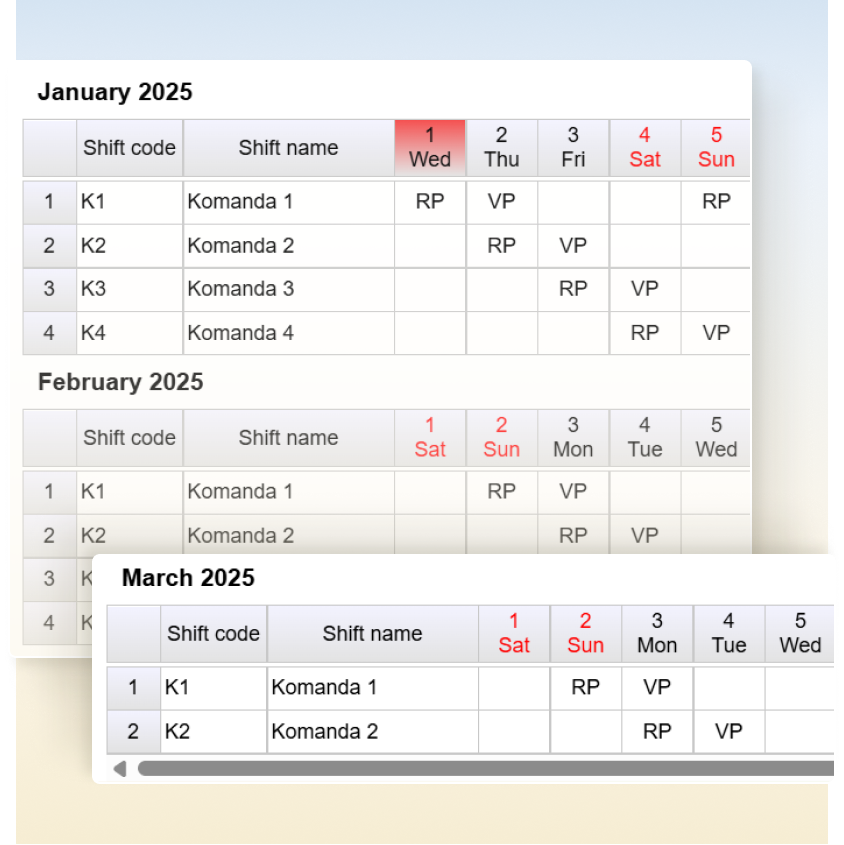
Absences & changes registered
Absences approved by the line manager. Time records update immediately on approval.
Labour law validated
Every schedule checked against statutory rules for Lithuania, Latvia, or Estonia and Poland before saving.
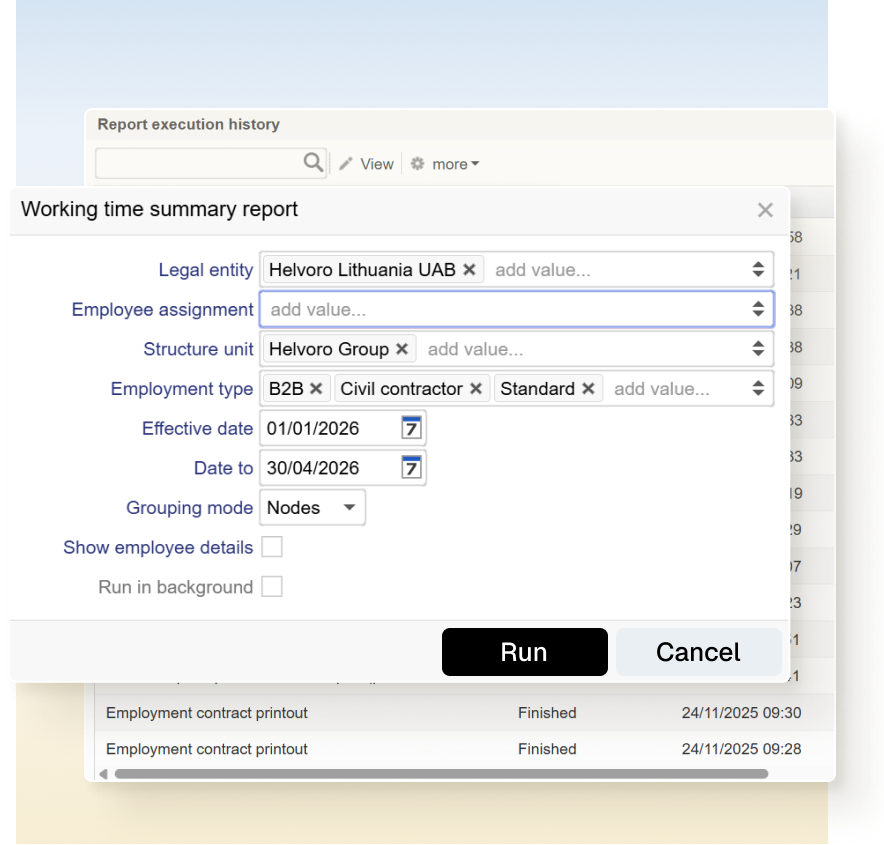
Data locked & handed to payroll
When the payroll period opens, time data freezes. Payroll receives validated totals – nothing to reconcile.
Working time enters the system through schedule planning, absence requests, extra work requests, or direct import from clocking hardware. All sources feed a single time record per employee.
Normative hours, overtime thresholds, daily limits, and rest periods applied automatically based on each employee's legal entity – Lithuania, Latvia, or Estonia and Poland. No manual rule configuration required.
Time data is locked when the payroll period opens. Overtime is calculated at period end against statutory normative adjusted for absences. Payroll receives the result.
Make sure your payroll is always correct.
A production manager checks her team's overtime balances before approving next week's extra shifts. A payroll specialist reviews what is coming in before the period closes. HR tracks sick leave across entities without running a separate report.
Vacation accruals, absence histories, working time summaries – available for any employee, any period, directly from the system. Working time data exports to financial systems and third-party tools in structured format.
Grafik Optymalny and Hermetis are two of the most capable tools available for shift-based operations in this region – one built for the complexity of operational scheduling, the other built for the compliance and payroll accuracy that has to follow from it.
Used together, they cover the full process: Grafik producing schedules optimised for operational demand, Hermetis ensuring those schedules are validated against statutory labour law, connected to absence records, and translated into payroll inputs that are correct before the run begins. For manufacturing and retail operations where scheduling precision and payroll accuracy both matter, the combination removes the gap that typically exists between the two.

“Absences management is where we lost most time and efficiency. Before implementing Hermetis 1200 hours were spent across the company.”
Uldis Vilks
Head of IT, Kronus
Popular integrations
SAP
NetSuite
MS Azure
Financial & Accounting Systems
Human Capital Management Systems
Data Platforms
ERP Systems
Integrations
Hermetis integrates with the tools your HR, payroll, and IT teams already use – clocking hardware, financial systems, identity providers, and third-party payroll tools. Standard integrations are available out of the box. Customer-specific connections are scoped separately.
SSO via OAuth 2.0 and user sync from Microsoft Azure Entra ID are included as standard. GL export connects working time and payroll data to your financial system. API access is available for system-to-system integration.
Open API. Secure, consistent, and fully traceable payroll data across all your systems.
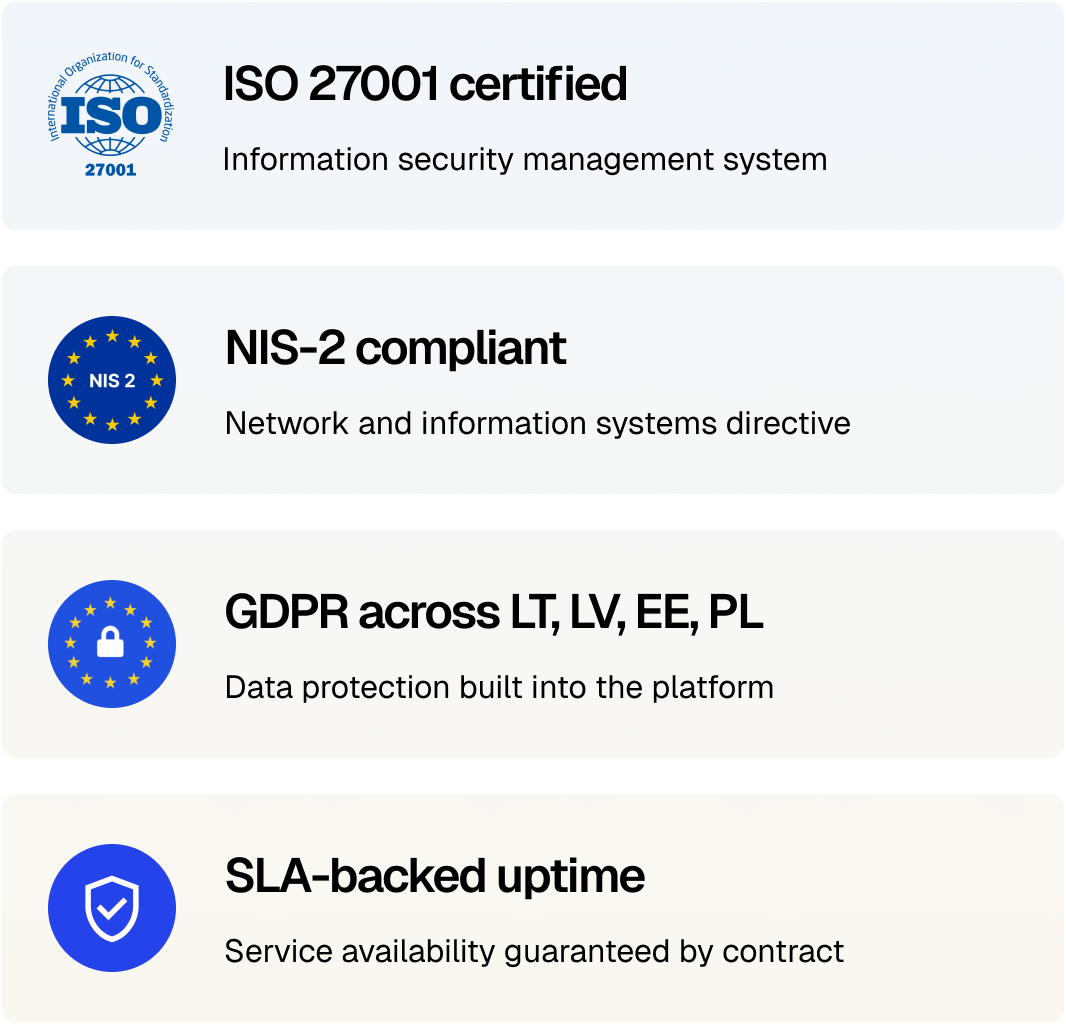
Employee working time data: hours, absences, schedules – stays within the legal entity it belongs to. Lithuania data does not cross into Poland. Each entity's records are isolated, auditable, and governed by the data residency rules of that country.
Access to working time records is role-based and defined by you.
Every access and every change is logged. When an auditor asks who changed a schedule and when, the answer is in the system.
Find out more about how it can work for you so that your payroll is always correct.
Shift cycle definitions are set once, used to generate a whole year's shift schedules, then reviewed, adjusted, approved, and assigned so rotating-shift operations get a year of schedules in minutes rather than rebuilding plans by hand. Standard-mode schedules are generated automatically from each jurisdiction's statutory normative calendar and the employee's FTE. Approved absences appear in the shift schedule for visibility so planners can arrange cover, without altering the originally planned shift.
Extra work is registered through dedicated requests and classified automatically into statutory categories. Overtime, rest-day work, public-holiday work, night work, on-call, travel time each with the correct premium treatment. For summarised accounting, overtime or shortage is recognised at the end of the accounting period as the difference between actual hours and the statutory normative adjusted for justified absences, which avoids the common error of counting it day by day.
No. Employees do not edit timesheets directly. The timesheet is built from approved absence requests and approved extra-work requests, so the actual-time record is controlled and auditable rather than self-entered. Worked time can also be imported automatically from clocking systems. Corrections after a timesheet closes are made as new versioned corrective timesheets with a full audit trail.
Working-time data, schedules and timesheets, locks automatically at the payroll-related freeze event, so payroll receives validated, payroll-ready totals already classified by statutory category, with nothing to match up by hand. Anything that needs to change after the freeze goes through a controlled corrective mechanism and, if it affects a closed period, through retroactive recalculation in Payroll so late changes are deliberate and traceable.
Each country's statutory working-time limits, daily and weekly rest, maximum daily hours, break entitlements, and overtime caps are applied automatically from each employee's Legal Entity and checked the moment a schedule is saved. Hard validations block a schedule that would breach a statutory limit; soft validations warn the planner but allow a deliberate, recorded override. Because the rules are maintained per country, a planner does not need to know each jurisdiction's limits by heart to stay compliant.
Sickness-absence data is imported from the authority portals. Sodra in Lithuania, E-veselība in Latvia, and Haigekassa in Estonia. Rather than re-written from paper certificates, and late or corrected certificates are handled through controlled corrective absence records after a timesheet has closed. Estonia's link is the most direct; some flows elsewhere remain file-based due to authority-side limitations.
Clocking hardware integrations are scoped per customer based on the specific device or system in use. File-based and API-based connections are both supported; specific connectors are scoped during implementation.