€145K
Net savings in year one
from absence management and organisational reporting alone.
Fragmented systems and manual processes create costs that are measurable, and recoverable.
HR hours, payroll re-entry, manager time absorbed in coordination
Every manual HR process has an hourly cost that compounds with headcount – absence requests by email, working time entered by hand, payslip queries that reach HR because employees have nowhere else to look. Across each entity, this is the standard weekly workload, not an exception.
Absence requests – paper, email, manual balance checks
Working time entered by hand into payroll
HR answering questions employees could answer themselves
Payroll recalculations from late or incorrect upstream data
Four contracts, four audits, four integrations – none connected
A separate vendor per country means four contracts, four security audits, four integration projects, and four sets of compliance obligations. The cost does not appear on any single invoice – it appears in the hours IT, HR, and payroll teams spend maintaining a structure that was never designed to work as a whole.
Four vendor contracts, each renewed independently
Four security audits per compliance cycle
No consolidated cost view without manual assembly
Every legislation change requires four separate responses
Fines, corrections, and management time when obligations are missed
In a manual system, compliance across Lithuania, Latvia, Estonia, and Poland depends on people tracking rules that differ by country and change when legislation is updated. The cost of missing an obligation appears in corrections, fines, and the management time those events consume.
Probation and contract deadlines tracked manually per country
Statutory reporting filed by people, not by the system
Legislation changes require manual process updates
No audit trail without deliberate manual documentation
The figures below are documented outcomes from Kronus, a Latvian manufacturer of 600 employees, who built their business case on an internal calculation of current process costs before committing to the investment.
€145K
Net savings in year one
from absence management and organisational reporting alone.
1455 hrs
Reduction in full administrative time
per year from absence management.
260 hrs
Reduction in HR administrative time
per year from organisational structure and reporting.
Year one
The annual administrative cost of their existing processes exceeded the implementation investment.
The project paid for itself before the end of year one.
Calculated against their internal cost of labour and the margin contribution of production employees whose time was previously absorbed in HR coordination.
Lorem ipsum dolor sit amet, consectetur adipiscing elit. Suspendisse varius enim in eros elementum tristique. Duis cursus, mi quis viverra ornare, eros dolor interdum nulla.

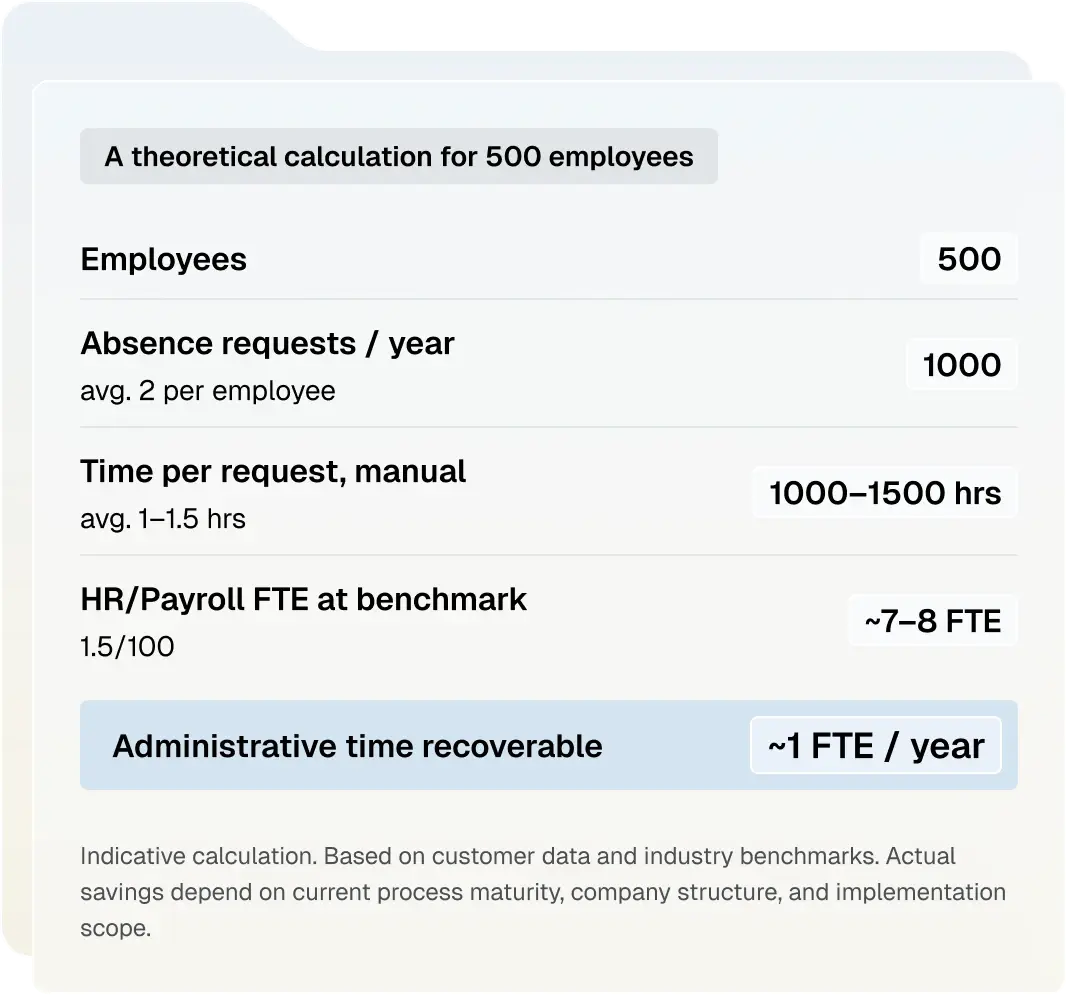
Based on data from our customers, a company of 500 employees with standard HR and payroll processes recovers between 1,000 and 1,500 hours of administrative time per year, equivalent to one full HR or payroll position – from absence management alone. This is before counting time recovered from payroll corrections, reporting, and the reduction in routine HR queries.
The starting point for any calculation is your current HR and payroll headcount. Industry benchmarks place HR staffing at 1.2 to 1.7 professionals per 100 employees in mid-sized companies, meaning a company of 500 people typically employs between 6 and 9 HR professionals. In manufacturing and retail, where compliance and scheduling complexity is higher, the ratio is often closer to 1:100.
Benchmarks: SHRM Human Capital Benchmark Report (1.7/100), Bloomberg Law HR Benchmarks (1.5/100), Forbes/ADP data (1.22–2.6/100 by size). Individual ratios vary by industry, structure, and HR technology maturity.
Across Lithuania, Latvia, Estonia, and Poland, payroll errors are rarely
the result of miscalculation, they are the result of incorrect or late data
arriving from upstream processes. Working time entered manually. Absence records that did not reach the payroll system in time. Employment changes processed in one entity that were not reflected in another.
The outcome is a payroll cycle that closes without a reconciliation exercise at the end of every month.
Each country's payroll runs in full isolation a change in Latvia does not affect Lithuania
Statutory taxes and social contributions calculated per country legislation automatically
Retroactive correction – built in no manual recalculations when employment data changes late
Every payroll result traceable to its source input results cannot be edited after period close
SEPA payment file generated after each cycle upload directly to bank, no reformatting
Enter your employee count and current process details.
We will show you what the recoverable cost looks like for a company of your size – based on documented outcomes from our customers.
Taking a system investment to a CFO requires a calculation specific to your organisation – your employee count, your current process costs, your vendor landscape, presented in terms a financial decision-maker will recognise.
Book a meeting. We will work through the numbers with you before you commit to anything.
We establish a confidential working relationship before any financial data is shared.
We establish how the investment needs to be structured for your organisation's financial model.
We map your current HR headcount, process hours, and vendor spend across each country entity.
We run the calculation against your inputs and our customer benchmarks, with assumptions visible.
You receive a structured business case ready to present to your CFO or board – before any commitment.
It is a calculation, backed by a customer who ran the numbers before and after.
Didn't find your answer? Get in touch — we'll get back to you.
From three places. Manual work falls because payroll calculates automatically, recalculates past periods on its own, and shares one employee record across modules so nothing is re-keyed. Routine compliance no longer needs country-specific external consultants, because legislative updates ship as maintained configuration. And error rates drop, which cuts the corrections, audit findings, and overpayments that quietly cost the most.
Three things. First, how much manual checking and outside-bureau cost your current payroll carries the higher these are, the faster Hermetis pays back. Second, how many Legal Entities you consolidate cost per employee falls as you add entities, so multi-country groups see the strongest return. Third, the quality of your starting data clean master data speeds go-live and cuts the correction cycles that drain payroll teams. We model your specific case in the discovery conversation rather than quoting a generic figure.
Not necessarily. Hermetis can run alongside what you already have for example as a payroll-only engine while your corporate HRM stays the master of employee data so you don't have to rip out a working system to start. A full migration is supported when you want it, but it is an option rather than a precondition, which lets you adopt Hermetis one entity or one function at a time.
Yes. We run a discovery conversation that maps your current costs compliance effort, administrative time, error and correction rates against running the same work on Hermetis, modelled on your actual entity count and headcount rather than a generic figure. It carries no commitment to proceed.
Licensing is based on the number of Legal Entities, the modules you use, and active employees, and cost per employee falls as the organisation grows so adding headcount or entities is proportionally cheaper per person rather than linear. The practical effect for a growing group is that the HR and payroll function can stay roughly flat in headcount while the business expands.
Implementation includes role-based training for HR, payroll, and IT, with each role learning the parts they actually use rather than the whole system. Time to full proficiency typically runs from a few weeks to a few months depending on role complexity, and documentation plus direct access to Hermetis experts continues after go-live, so the team is not left on its own once the project closes.
Manual HR and payroll work scales with headcount and with the number of countries you operate in, and error rates and audit exposure compound in multi-jurisdiction setups: more reconciliation by hand, more correction cycles, and more exposure at audit. The aim with Hermetis is to keep the HR and payroll function roughly flat in headcount as the business grows, by removing the repetitive work and the country-by-country consultant dependency. We model the specific cost against your own numbers in a discovery conversation.