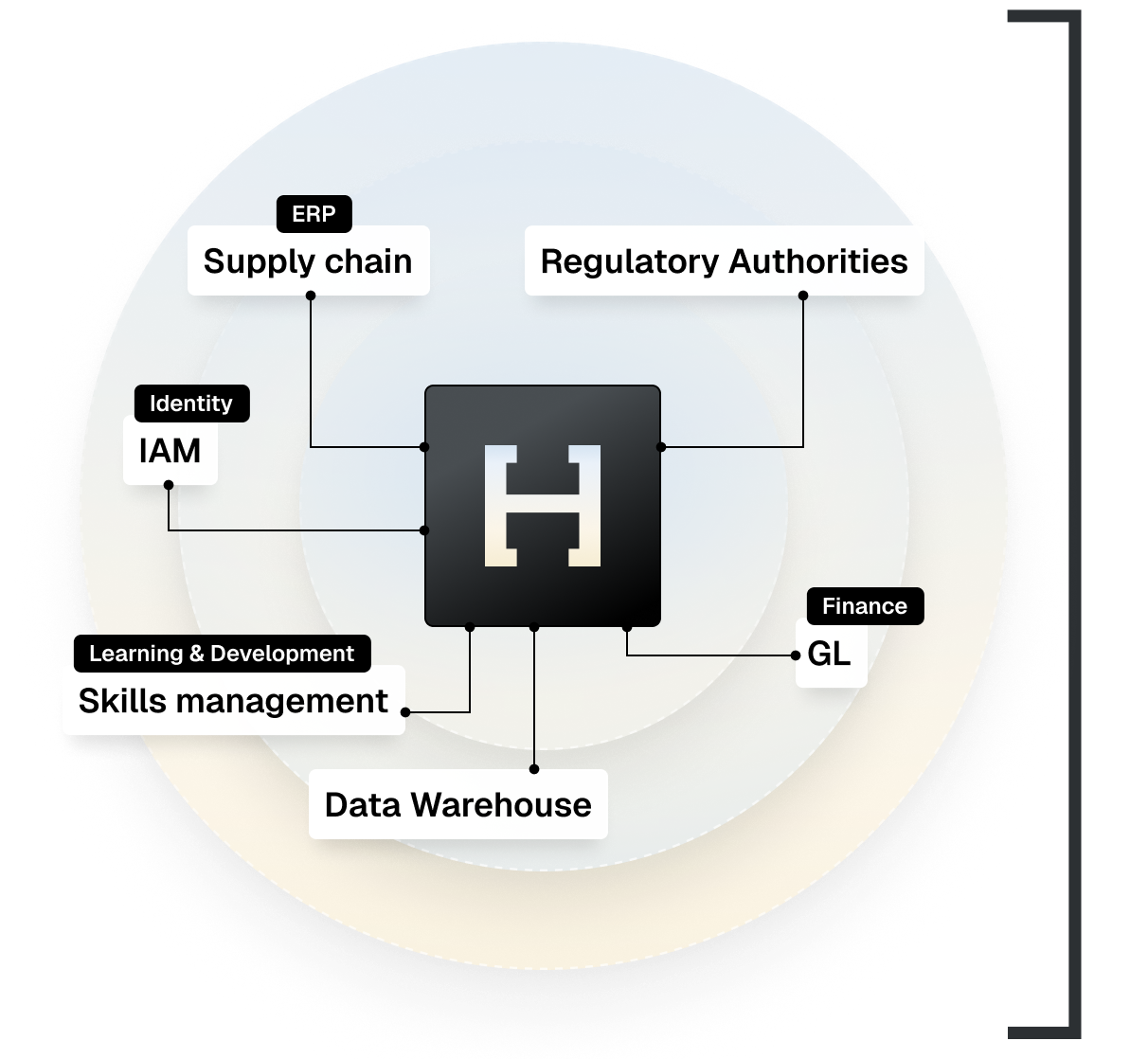
Hermetis does not mean closed.
Hermetis connects to your existing systems through an open RESTful API.
Whether you run Workday globally and need local payroll in Lithuania, or manage HR across four countries with no central system at all – Hermetis integrates without requiring you to replace what is already working.
Companies that chose Hermetis
One integration model does not fit every IT landscape.
Hermetis is implemented into an existing IT environment in most cases.
The scope of integration, and which system takes primary responsibility for each dataset – depends on what is already in place.
We have defined four integration models that cover the most common scenarios. Each reflects a real architecture we have worked with.

How we typically structure integrations with our customers.
When Hermetis owns the full HR and payroll cycle, integration is simpler and data is more reliable.
When we sit alongside existing systems, we are honest about what that means, and we scope it carefully.
Hermetis owns the full cycle
- HR master data downstream systems (complete integration)
- Governmental authorities data received from regulatory bodies
- Salary and taxation data exported to financial system
Hermetis alongside your HRM
- HR master data received from 3rd party HRM system
- Governmental authorities data received from regulatory authorities
- Salary and taxation data exported to financial system
Hermetis handles payroll only
- HR master data and working time received from 3rd party
- Governmental authorities data received from regulatory authorities
- Salary and taxation data exported to financial system
Hermetis manages HR – third party handles payroll
- HR master data sent to 3rd party payroll system
- Working time and absences sent to payroll provider
- Salary data received from provider for display
All integrations run on a single open RESTful API.
Every data transfer uses RESTful API connections – secure, documented, and initiated by either side. No proprietary connector, no middleware layer, no integration that requires months of custom development before it can be tested.
The API is versioned, changes are communicated in advance, and documentation is available to your technical team before any commercial commitment.
Popular integrations

SAP

Workday

NetSuite

MS Azure
Financial & Accounting Systems
- SAP
- Oracle
- NetSuite
- Xero
- AXAPTA
Human Capital Management Systems
- Workday
- SAP SuccessFactors
Data Platforms
- SharePoint
- MS Azure
ERP Systems
- Rivile
Integrations
Integrations we have built with our customers.
Connect payroll with your HR, finance, and data systems, without manual transfers or inconsistencies.
- Sync employee and payroll data across systems
- Eliminate manual data transfers and reconciliation
- Ensure accurate, audit-ready data at every step
Open API. Secure, consistent, and fully traceable payroll data across all your systems.
One of the most common Payroll problems is incorrect data
If payroll is already handled, internally or by an outsourcing provider – the question is not whether the calculation is correct. It is whether the calculation receives correct inputs every time.
Hermetis manages the data that drives payroll accuracy: employee records, contract details, absence records, working time, social security and pension contribution parameters, and individual tax exemption status. Every change goes through a controlled, approval-driven workflow. Every update is available to payroll immediately, no re-entry, no drift.
- Employee records and contract details
- Absence records and working time
- Social security and pension contribution parameters
- Individual tax exemption status per country
- Statutory reporting per LT / LV / EE / PL authority
Hermetis as the core of your entire HR technology stack.
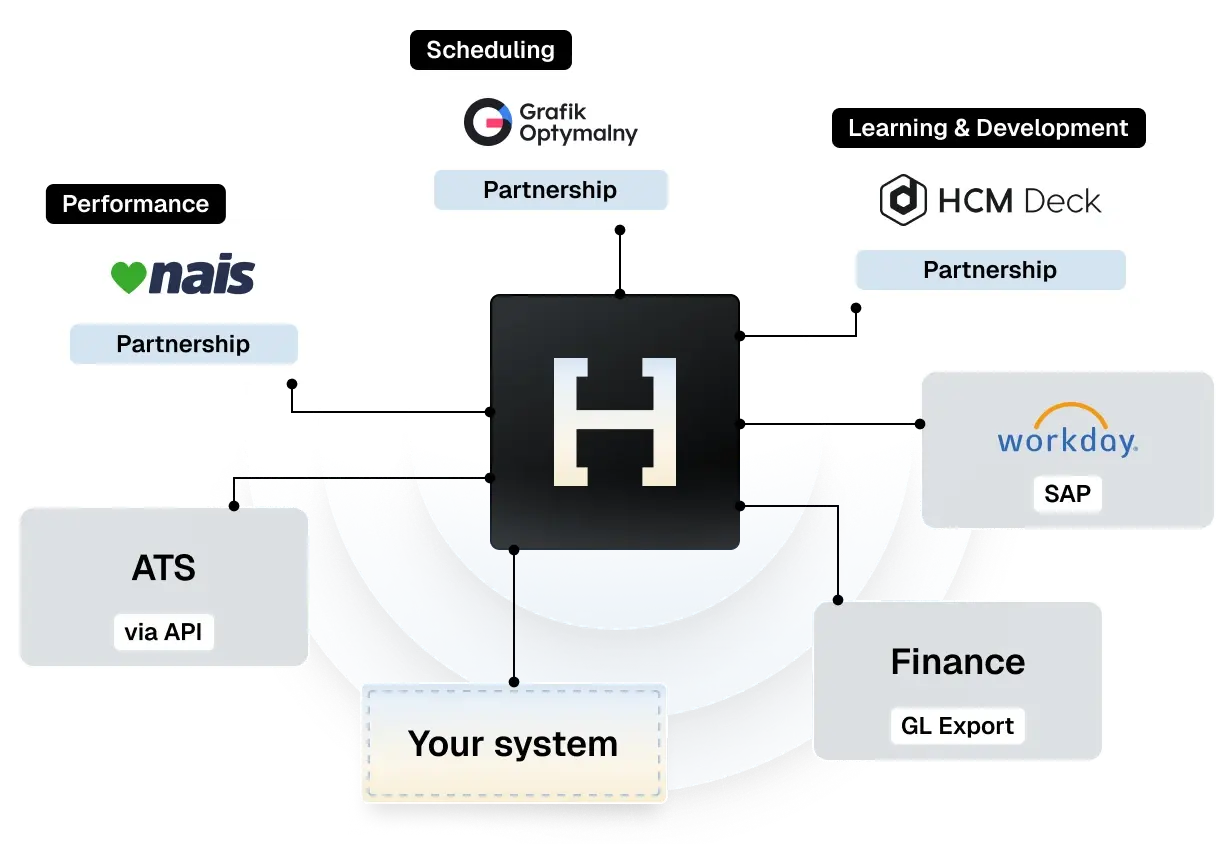
Most organisations do not run one HR system. They run five. An ATS that does not talk to payroll. A scheduling tool that exports to Excel. A learning platform that has never heard of your org structure. Performance reviews conducted in a system that does not know who works for whom.
Hermetis is built to be the hub. Employee data – who someone is, what they earn, who they report to, how many days they have left, lives in one place and flows outward to every tool that needs it. When that data changes, everything downstream changes with it. Automatically.
That is what a digital HR powerhouse looks like in practice. Not ten systems talking to each other. One system that the others trust.
Medium length section heading goes here
Lorem ipsum dolor sit amet, consectetur adipiscing elit. Suspendisse varius enim in eros elementum tristique. Duis cursus, mi quis viverra ornare, eros dolor interdum nulla.
- Build, approve, and process working time schedules
- Register absences – time records update on approval
- Automated statutory payments and audit-ready records

Learning and development
When an employee's role changes in Hermetis, HCM Deck knows immediately – their learning path updates, their compliance training resets, their history follows them. No manual synchronisation, no stale records.
Advanced scheduling
Shift plans built in Grafik Optymalny flow directly into Hermetis working time records – validated against labour law, ready for payroll. The hours your employees work are the hours that get paid. No re-entry, no Friday reconciliation.

Performance and recognition
Recognition and performance data in Nais is anchored to real employee records from Hermetis – org structure, tenure, role. Managers see the full picture. HR does not have to maintain it in two places.
Integration is not a handover. It is an ongoing relationship.
Our team stays involved after go-live. When your IT landscape changes – a new system, a new country, a legislation update, we adapt the integration with you.
The people who built the integration know your architecture. They are the same people you call when something needs to change.
Your IT landscape does not need to change for Hermetis to work.
Book a technical discussion. We will review your system landscape, identify which integration pattern fits, and give your technical team access to the API documentation before any commercial decision is required.
Frequently asked questions
Didn't find your answer? Get in touch — we'll get back to you.
Technical and integration
What does the API authentication model look like – how do systems authenticate to call the Hermetis API?
Is the API RESTful and does it support both push and pull data flows?
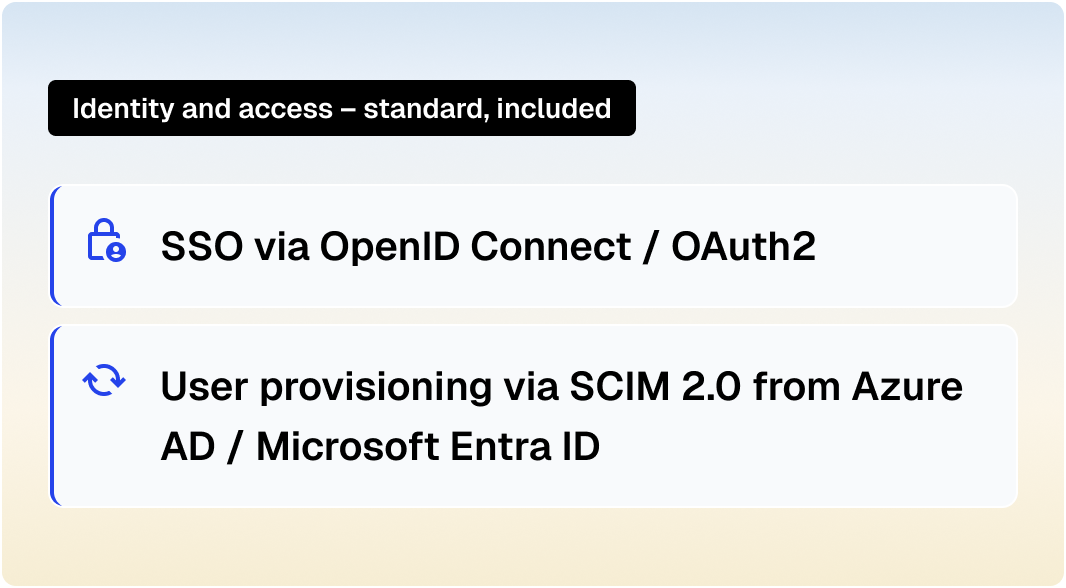
How is SCIM 2.0 provisioning structured, which Hermetis objects map to SCIM resources?
SCIM 2.0 provisioning is supported for user and group lifecycle synchronization. Hermetis employee records and access rights map to SCIM User and Group resources. SCIM is typically used alongside an identity provider (Microsoft Azure Entra ID) for centralized provisioning, deprovisioning, and group membership across Legal Entities.
How are field-level mapping and data transformation handled between Hermetis and a third-party HRM system?
Field-level mapping between Hermetis and an external HRM is configured during integration setup. Standard mappings exist for common fields (personal data, employment, organizational assignment). Transformations — date formats, code conversions, derived fields — are applied at the integration layer rather than in either source system. Mapping definitions are versioned and reviewed when the source system schema changes.
What is the API versioning strategy – how are breaking changes communicated and managed?
The Hermetis API uses semantic versioning. Non-breaking changes (additive fields, new endpoints) are released continuously. Breaking changes are versioned explicitly and announced in advance with a deprecation window. Older API versions remain available during the deprecation window to allow integration upgrades.
Does Hermetis support data residency requirements – where exactly is data processed and stored?
Customer data is processed and stored in data centres located in the European Union. Each Legal Entity's data resides in the country jurisdiction it belongs to. Data residency boundaries are enforced at the platform level — Lithuanian data does not cross into Latvia, Latvian data does not cross into Estonia. Cross-region replication is not used for primary storage.
What integration testing environment is available, is there a sandbox or staging instance?
Hermetis provides a separate non-production environment for integration testing during implementation. The environment uses sanitized data and supports the same API surface as production. Post-go-live, customer-specific test environments can be provisioned for integration validation against major releases or new connections.
How does Hermetis handle error states and failed data transfers – is there retry logic and alerting?
Failed API calls and integration runs are logged with structured error context (timestamp, endpoint, error code, payload reference). Retry logic with exponential backoff is built into platform-managed integrations. Alerting on persistent failures is delivered to designated integration owners through email or, optionally, through the customer's monitoring stack.
General
Can Hermetis operate as a fully standalone system with no outbound integrations?
Can each legal entity use a different integration flow?
Is the API documentation publicly available?
API documentation is available to customers and implementation partners through the customer portal. Public documentation outside an active engagement is not currently published.
What happens to the integration if our primary HRM system is replaced or upgraded?
When a primary HRM is replaced or upgraded, the integration is reviewed and reconfigured against the new system's interface. Existing employment data, history, and payroll continuity are preserved — Hermetis retains its own source of truth for payroll-relevant data while syncing employee master data from the new source.
Can Hermetis export data to a data warehouse or BI platform?
Yes. Hermetis supports integration with BI tools and data warehouses for reporting and analysis. Both file-based exports and API-based extraction are supported. Customers typically connect to internal warehouses (Snowflake, BigQuery, Microsoft Fabric) or BI tools (Power BI, Tableau) — the connection model is selected based on data volume and refresh requirements.